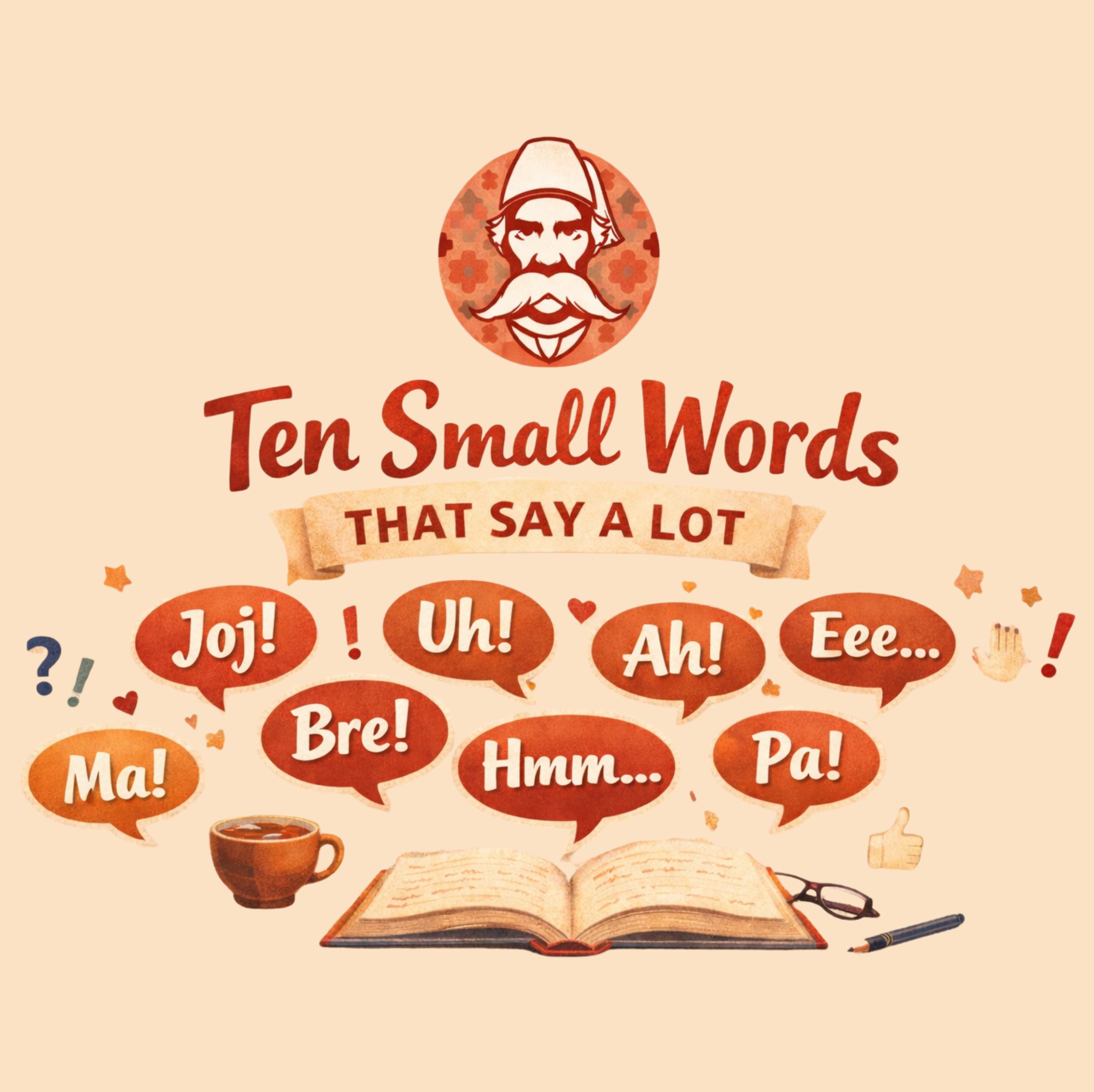
If you are learning Serbian, you are probably one of those learners who, while worrying about big things like cases, verb aspects, and complex grammar rules, often forgets to discover the meaning of some very small words such as joj, ah, uh, or bre.
And yet, these little words are everywhere.
They may look simple, but from language to language they vary greatly in meaning and usage, and they often carry emotion, attitude, and context that grammar alone cannot express.
That’s why we have selected 10 small but powerful Serbian words that native speakers use in everyday conversation — words that can express a wide range of feelings, reactions, and thoughts.
1. Joj (јој)
Meaning: Oh / Oh no / Oh dear
When it’s used:
- surprise
- mild panic
- concern or empathy
Example:
- Joj, zaboravila sam ključeve.
Oh no, I forgot my keys.
Explanation:
“Joj” is one of the most common spontaneous reactions in Serbian. It is emotional and instinctive. Depending on intonation, it can sound dramatic, caring, annoyed, or even playful.
2. Bre (бре)
Meaning: no direct equivalent (emotional intensifier)
When it’s used:
- to add emphasis
- to express irritation
- in friendly teasing
Example:
- Hajde, bre, požuri!
Come on, hurry up!
Explanation:
Bre does not change the literal meaning of a sentence, but it changes its emotional weight. It can sound warm and friendly or sharp and annoyed — tone is everything.
3. Aha (аха)
Meaning: I see / Got it
When it’s used:
- understanding
- realization
Example:
- Aha, znači dolaziš sutra.
I see, so you’re coming tomorrow.
Explanation:
Aha signals that the speaker has processed the information. It can be sincere or slightly skeptical, depending on context.
4. Ahaaa (ахааа)
Meaning: Ohhh, now I get it!
When it’s used:
- sudden realization
- discovering a hidden reason
Example:
- Ahaaa, zato si ćutao!
Ohhh, that’s why you were quiet!
Explanation:
The extended sound emphasizes the moment of realization and often adds humor or irony.
5. Uh (ух)
Meaning: Ugh / Whew
When it’s used:
- exhaustion
- stress
- relief
Example:
- Uh, ovo je bilo naporno.
Ugh, this was exhausting.
Explanation:
Uh can express physical tiredness or emotional pressure. In some contexts, it can also express relief after something difficult ends.
6. Ah (ах)
Meaning: Ah
When it’s used:
- nostalgia
- sadness
- romantic or emotional reflection
Example:
- Ah, kako je nekad bilo lepo…
Ah, how beautiful things used to be…
Explanation:
Ah is softer and more emotional than uh. It often carries a reflective or sentimental tone.
7. E (е)
Meaning: Well / So
When it’s used:
- starting a sentence
- changing the topic
- making a decision
Example:
- E, sad ćemo ovako.
Well, we’ll do it like this now.
Explanation:
This tiny word is extremely common in spoken Serbian and helps the conversation flow naturally.
8. Pa (па)
Meaning: Well / So
When it’s used:
- softening an answer
- introducing an explanation
Example:
- Pa ne znam baš.
Well, I’m not really sure.
Explanation:
Without pa, Serbian speech can sound too direct or abrupt. It adds politeness and hesitation.
9. Ma (ма)
Meaning: Come on / Nah / It’s nothing
When it’s used:
- dismissing something
- minimizing a problem
- rejecting a topic
Example:
- Ma nije to važno.
Oh, that’s not important.
Explanation:
Ma is often used to emotionally close a topic or downplay its importance.
10. Ej (еј)
Meaning: Hey
When it’s used:
- getting attention
- informal, friendly interaction
Example:
- Ej, čekaj malo!
Hey, wait a second!
Explanation:
Ej sounds casual and friendly and is very common in everyday speech.